$$
\newcommand{\SetN}{\mathbb{N}}
\newcommand{\SetR}{\mathbb{R}}
\newcommand{\SetC}{\mathbb{C}}
\newcommand{\SetK}{\mathbb{K}}
\newcommand{\SetZ}{\mathbb{Z}}
\newcommand{\SetQ}{\mathbb{Q}}
\newcommand{\SetU}{\mathbb{U}}
\newcommand\ds[0]{\displaystyle}
\newcommand\PCar[1]{\large{\chi}_{#1}}
\newcommand{\=}{\:=\:}
\newcommand\tendvers[2]{\displaystyle\mathop{\longrightarrow}_{#1\rightarrow#2}}
\newcommand\tr[0]{\:^t\!}
\newcommand\limite[2]{\displaystyle\mathop{\text{lim}}_{#1\rightarrow#2}\:}
\newcommand\Sup[1]{\displaystyle\mathop{sup}_{#1}}
\newcommand\Inf[1]{\displaystyle\mathop{inf}_{#1}}
\newcommand\Haut[1]{}
\newcommand\vect[1]{\overrightarrow{#1}}
\newcommand\tendversCU[0]{\:\displaystyle\mathop{\Large\longrightarrow}_{n\rightarrow+\infty}^{_{CU}}\:}
\newcommand\tendversCS[0]{\:\displaystyle\mathop{\Large\longrightarrow}_{n\rightarrow+\infty}^{_{CS}}\:}
\newcommand\tendversCN[0]{\:\displaystyle\mathop{\Large\longrightarrow}_{n\rightarrow+\infty}^{_{CN}}\:}
\newcommand\tendversCUS[0]{\:\displaystyle\mathop{\Large\longrightarrow}_{n\rightarrow+\infty}^{_{CUS}}\:}
\newcommand\tendversNorme[1]{\:\displaystyle\mathop{\Large\longrightarrow}_{n\rightarrow+\infty}^{#1}\:}
\newcommand\simL[0]{\displaystyle\mathop{\sim}_{^{^L}}}
\newcommand\simC[0]{\displaystyle\mathop{\sim}_{^{^C}}}
\newcommand\simLC[0]{\displaystyle\mathop{\sim}_{^{^{LC}}}}
\newcommand\fonction[5]{
\begin{array}{cccc}
#1\::\:& #2 & \rightarrow & #3 \\
& #4 & \mapsto & \ds #5 \
\end{array}}
$$
| Liste chapitres |
Plan du chapitre |
 | Section |  |
|
| sous-section | |
|
|
|
| Ici sera la liste des chapitres !!! |
|
III. Interversion de limites.
III.1. Interversion limite-intégrale.
Théorème.21
Soit $(f_n)$ une suite de fonctions continues définies sur le segment $[a,b]$.
$$
f_n\tendversCU f
\hskip0.9cm\Longrightarrow\hskip0.9cm \limite{n}{+\infty}\int_a^bf_n\=\int_a^b\limite{n}{+\infty}f_n\=\int_a^bf
$$
Remarques.22
- On suppose les fonctions $f_n$ continues pour avoir automatiquement $f$ continue grâce au théorème de conservation de la continuité par CU. On est ainsi sûr que $\int_a^b f$ a un sens. On peut très bien supposer les $f_n$ juste continues par morceaux, mais dans ce cas il faut :
- Soit améliorer notre construction de l'intégrale pour donner un sens aux intégrales des limites des fonctions continues par morceaux $($cad les fonctions réglées$)$. Ça existe, mais c'est hors programme.
- Soit remplacer l'hypothèse $f_n$ continues par $f_n$ continues par morceaux et $f$ continue par morceaux.
Le programme propose le théorème qui est dans l'encadré.
-
Le théorème est faux si l'intégrale n'est pas sur un segment. Prendre $$f_n(x)=\left\{\begin{array} {lll}%
\frac{1}{n}&\hbox{si}&x\in[0,n]\\
\Haut{0.5}0&\hbox{si}&x\in[n,+\infty[\\
\end{array}\right.%
$$
-
Le théorème est faux s'il n'y a pas convergence uniforme. Prendre pour $n\geq 2$ la suite de fonctions $(f_n)$ définie sur $\SetR^+$ par : $$f_n(x)=\left\{\begin{array} {ccc}%
n^2x&\hbox{si}&x\in\left[0;\frac{1}{n}\right]\\
\Haut{0.5}2n-n^2x&\hbox{si}&x\in\left[\frac{1}{n};\frac{2}{n}\right]\\
\Haut{0.5}0&\hbox{si}&x\in\left[\frac{2}{n};1\right]\\
\end{array}%
\right.$$
- Reformulation dans le cadre des séries de fonctions. Le théorème est alors appelé intégration termes à termes.
Soit $(f_n)$ une suite de fonctions continues définies sur le segment $[a,b]$ telle que la série $\sum f_n$ converge uniformément alors
$$
\int_a^b\sum_{n=0}^{+\infty}f_n\:\=\:\sum_{n=0}^{+\infty}\int_a^bf_n
$$
Exercice - théorème des moments.23
Soit $f$ une fonction continue sur $[a,b]$ vérifiant :
$$\forall P\in\SetR[X],\:\:\int_a^bf(t)P(t)dt\=0$$
- Montrer en utilisant le théorème de Bernstein que : $\ds\int_a^bf^2=0$.
- En déduire que $\:\SetR[X]^\perp=\{0\}\:$ dans l'espace pré-hilbertien $\mathcal{C}([a,b],\SetR)$
Exercice.24
- Soient $n$ et $p$ dans $\SetN$. Montrer que l'intégrale suivante est convergente, puis la calculer :
$$I_{pn} \=\int_0^1x^p\ln^n(x)dx$$
- Pour tout $n$ de $\SetN^*$, notons $f_n$ l'application de $[0,1]$ dans $\SetR$ définie par :
$$f_n(x)=\left\{\begin{array} {ccc}%
x^n\ln^n(x)&\text{si }x>0\\
0&\text{si }x=0\\
\end{array}%
\right.$$
On note également $f_0=1$. Montrer que pour tout $n$ de $\SetN$, l'application $f_n$ est continue et bornée par 1.
- Pour tout $x$ de $[0,1]$, notons : $$f(x) = \sum_{n=0}^{+\infty}\frac{(-1)^nf_n(x)}{n!}$$ Montrer que la convergence définissant $f$ est uniforme.
- En déduire que : $$\int_0^1\frac{1}{x^x}\=\sum_{n=1}^\infty\frac{1}{n^n}$$
|
III. Interversion de limites.
III.2. Interversion limite-dérivabilité.
Rappel.
La dérivabilité n'est pas conservée par CS/CU/CUS/CN.
Théorème de dérivation des suites de fonctions.25
Soit $(f_n)$ une suite de fonctions $C^1$ sur $I$ telle que :
$$\left\{\begin{array} {ccc}%
f_n\tendversCS f\\
\Haut{0.5}f'_n\tendversCUS g\\
\end{array}%
\right.\hskip0.5cm\Longrightarrow\hskip0.5cm f\hbox{ est $C^1$ et }f'=g$$
De plus la convergence de $f_n$ vers $f$ est uniforme sur tout segment.
Théorème $C^p$ des suites de fonctions.26
Soit $(f_n)$ une suite de fonctions $C^p$ sur $I$ qui converge simplement vers $f$ et telle que :
$$\left\{\begin{array} {lcc}%
\left(f^{(k)}_n\right)\text{ CS}&\hbox{ pour k < p}\\
\left(f^{(p)}_n\right)\text{ CUS}
\end{array}%
\right.\hskip0.5cm\Longrightarrow\hskip0.5cm f\hbox{ est $C^p$ et }f^{(p)}=\limite{n}{+\infty}f_n^{(p)}$$
De plus la convergence de $(f_n)$ vers $f$ est uniforme sur tout segment.
Remarque.
S'il s'agit d'une série de fonctions, les théorèmes s'appellent théorèmes de dérivation termes à termes et s'énoncent ainsi $($avec la même régularité que des fonctions $(f_n)$ des théorèmes précédents :
$$\left\{\begin{array} {l}%
\ds\sum f_n\hbox{ CS}\\
\ds\Haut{0.65}\sum f'_n\hbox{ CUS}\\
\end{array}%
\right.\hskip0.5cm\Longrightarrow\hskip0.9cm \sum f_k\hbox{ est $C^1\hskip0.5cm$ et }\hskip0.5cm\left(\sum_{k=0}^{+\infty}f_k\right)'=\sum_{k=0}^{+\infty}f'_k$$
et
$$\left\{\begin{array} {ll}%
\ds\sum f^{(k)}_n\hbox{ CS}&\hbox{ pour k < p}\\
\ds\Haut{0.65}\sum f^{(p)}_n\hbox{ CUS}\\
\end{array}%
\right.\hskip0.5cm\Longrightarrow\hskip0.9cm \sum_{k=0}^{+\infty}f_k\hbox{ est $C^p\hskip0.5cm$ et }\hskip0.5cm\left(\sum_{k=0}^{+\infty}f_k\right)^{(p)}=\sum_{k=0}^{+\infty}f^{(p)}_k$$
Exercice.27
Montrer que la fonction : $$f(x)\=\ds\sum_{n=0}^{\infty}\frac{\sin(3^nx)}{4^n}$$ est dérivable sur $\SetR$. Déterminer $f'$.
|
III. Interversion de limites.
III.3. Interversion limite-limite.
Théorème de la double limite.28
Soit $(f_n)$ une suite $($ou une série$)$ de fonctions de $I$ dans $\SetK$ et $a$ une extrémité de $I$. Si
$$\left\{%
\begin{array} {l}%
f_n\tendversCU f\\
\Haut{0.5}f_n(x)\tendvers{x}{a}l_n
\end{array}%
\right.\hskip0.5cm\Longrightarrow\hskip0.5cm
\limite{n}{+\infty}l_n \hbox{ et } \limite{x}{a}f(x) \hbox{ existent et sont égales.}
$$
On peut résumer la situation sur le schéma suivant :
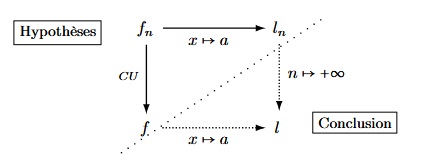
Sous forme condensée, on peut écrire :
$$\limite{x}{a}\limite{n}{+\infty}f_n(x)\=\limite{n}{+\infty}\limite{x}{a}f_n(x)$$
Exercice.29
Montrer que : $$\sum_{k=1}^{+\infty}\frac{(-1)^{k-1}}{k}\=\ln(2)$$
- En utilisant le théorème de la double limite et que sur $[0,1[$ :
$$\ds\ln(1+x)\=\sum_{k=1}^{+\infty}\frac{(-1)^{k-1}x^{k}}{k}$$
- Sans utiliser le théorème de la double limite et en intégrant la somme $\ds\sum_{k=0}^n(-x)^k$.
|