$$
\newcommand{\SetN}{\mathbb{N}}
\newcommand{\SetR}{\mathbb{R}}
\newcommand{\SetC}{\mathbb{C}}
\newcommand{\SetK}{\mathbb{K}}
\newcommand{\SetZ}{\mathbb{Z}}
\newcommand{\SetQ}{\mathbb{Q}}
\newcommand{\SetU}{\mathbb{U}}
\newcommand\ds[0]{\displaystyle}
\newcommand\PCar[1]{\large{\chi}_{#1}}
\newcommand{\=}{\:=\:}
\newcommand\tendvers[2]{\displaystyle\mathop{\longrightarrow}_{#1\rightarrow#2}}
\newcommand\tr[0]{\:^t\!}
\newcommand\limite[2]{\displaystyle\mathop{\text{lim}}_{#1\rightarrow#2}\:}
\newcommand\Sup[1]{\displaystyle\mathop{sup}_{#1}}
\newcommand\Inf[1]{\displaystyle\mathop{inf}_{#1}}
\newcommand\Haut[1]{}
\newcommand\vect[1]{\overrightarrow{#1}}
\newcommand\tendversCU[0]{\:\displaystyle\mathop{\Large\longrightarrow}_{n\rightarrow+\infty}^{_{CU}}\:}
\newcommand\tendversCS[0]{\:\displaystyle\mathop{\Large\longrightarrow}_{n\rightarrow+\infty}^{_{CS}}\:}
\newcommand\tendversCN[0]{\:\displaystyle\mathop{\Large\longrightarrow}_{n\rightarrow+\infty}^{_{CN}}\:}
\newcommand\tendversCUS[0]{\:\displaystyle\mathop{\Large\longrightarrow}_{n\rightarrow+\infty}^{_{CUS}}\:}
\newcommand\tendversNorme[1]{\:\displaystyle\mathop{\Large\longrightarrow}_{n\rightarrow+\infty}^{#1}\:}
\newcommand\simL[0]{\displaystyle\mathop{\sim}_{^{^L}}}
\newcommand\simC[0]{\displaystyle\mathop{\sim}_{^{^C}}}
\newcommand\simLC[0]{\displaystyle\mathop{\sim}_{^{^{LC}}}}
\newcommand\fonction[5]{
\begin{array}{cccc}
#1\::\:& #2 & \rightarrow & #3 \\
& #4 & \mapsto & \ds #5 \
\end{array}}
$$
| Liste chapitres |
Plan du chapitre |
 | Section |  |
|
| sous-section | |
|
|
|
| Ici sera la liste des chapitres !!! |
|
III. Variables aléatoires discrètes.
III.1. Définition.
Définitions.
- Une variable aléatoire discrête sur $(\Omega, \mathcal{A})$ à valeurs dans $F$ est une application $X$ définie de $\Omega$ dans $F$ telle que :
- $F$ est au plus dénombrable.
- Pour tout élément $x$ de $E$, $X^{-1}(\{x\})$ soit un événement c'est-à-dire appartienne à $\mathcal{A}$
- Une variable aléatoire est réelle si $F\subset\SetR$.
Programme PSI.
Il existe des variables aléatoires non discrètes, c'est-à-dire des applications dans un ensemble $F$ non dénombrable, mais c'est hors programme. Les variables aléatoires seront dorénavant des variables aléatoires discrètes.
Intérêts.
- L'intérêt d'une variable aléatoire est de changer l'univers $\Omega$ en un univers $F$ plus adapté à ce qu'on souhaite mesurer.
- La tribu associée à $F$ est alors $\mathcal{P}(F)$, ce qui signifie que tout sous-ensemble de $F$ est un événement.
- L'univers $\Omega$ n'est en général plus explicité puisque seul $X(\Omega)$ est important.
Notations.
- Pour alléger les notations, on définit les ensembles suivants, avec $a\in E$ et $A\subset E$ :
$$\begin{array} {ccccl}%
\{X=a\}&\:\ds\mathop{=}_{^\text{def}}\:&(X= a)&\:\ds\mathop{=}_{^\text{def}}\:&\{\:\omega\in\Omega\:/\:X(\omega)=a\:\} \\[0.2cm]
\{X\in A\}&\:\ds\mathop{=}_{^\text{def}}\:&(X\in A)&\:\ds\mathop{=}_{^\text{def}}\:&\{\:\omega\in\Omega\:/\:X(\omega)\in A\:\}
\end{array}%
$$
- Si $X$ est une variable aléatoire réelle, on a aussi :
$$\begin{array} {ccccl}%
\{X\geq a\}&\:\ds\mathop{=}_{^\text{def}}\:&(X\geq a)&\:\ds\mathop{=}_{^\text{def}}\:&\big\{\: \omega\in\Omega\:/\:X(\omega)\geq a\:\big\}\\[0.2cm]
\{X\leq a\}&\:\ds\mathop{=}_{^\text{def}}\:&(X\leq a)&\:\ds\mathop{=}_{^\text{def}}\:&\big\{\: \omega\in\Omega\:/\:X(\omega)\leq a\:\big\}\\[0.1cm]
\{X> a\}&\:\ds\mathop{=}_{^\text{def}}\:&(X> a)&\:\ds\mathop{=}_{^\text{def}}\:&\big\{\:\omega\in\Omega\:/\:X(\omega)> a\:\big\}\\[0.1cm]
\{X< a\}&\:\ds\mathop{=}_{^\text{def}}\:&(X< a)&\:\ds\mathop{=}_{^\text{def}}\:&\big\{\:\omega\in\Omega\:/\:X(\omega)< a\:\big\}\\[0.1cm]
\end{array}%
$$
- Si $P$ est une probabilité sur $(\Omega,\mathcal{A})$, alors les probabilités de ces événements sont notés : $P(X\in A)$, $P(X=a)$, $P(X\geq a)$...
Exemple.
On regarde la durée de vie en jours d'une ampoule fabriquée dans une usine et on considère $X$ la variable aléatoire à valeurs dans $F=\{\text{'Très bien'}, \text{'Bien'}, \text{'Passage'}, \text{'Nul'}\}$ définie par :
$$X(\omega)\=\left\{\begin{array}{lll}
\text{'Nul'}&\text{si }\omega\in[0;100[\\
\text{'Passable'}&\text{si }\omega\in[100;300[\\
\text{'Bien'}&\text{si }\omega\in[300;1000[\\
\text{'Très bien'}&\text{si }\omega\in[1000;+\infty[\\
\end{array}\right.$$
Cet exemple montre un exemple où l'univers $\Omega$ n'est pas dénombrable et pourtant la variable est discrète. Il donne également un exemple d'une variable aléatoire non réelle.
|
III. Variables aléatoires discrètes.
III.2. Loi d'une variable aléatoire.
Définitions.
- Soit $X$ une variable aléatoire sur l'espace probabilisé $(\Omega, \mathcal{A}, P)$ à valeurs dans $F$. La loi de $X$ est l'application :
$$
\fonction{P_{_X}}{\mathcal{P}(F)}{[0,1]}{A}{P(X\in A)}$$
- Deux variables aléatoires $X$ et $Y$ ont/suivent la même loi si $P_{_X}=P_{_Y}$, on note $X\sim Y$.
Méthode.22
La loi de la variable aléatoire discrète $X$ est entièrement déterminée par :
- $X(\Omega)$, l'ensemble des valeurs que peut prendre $X$.
- Les probabilités $P(X=x_k)$ avec $x_k$ dans $X(\Omega)$.
Ainsi, en pratique, lorsqu'on demande la loi de $X$, il faut fournir ces 2 informations.
Exemple.
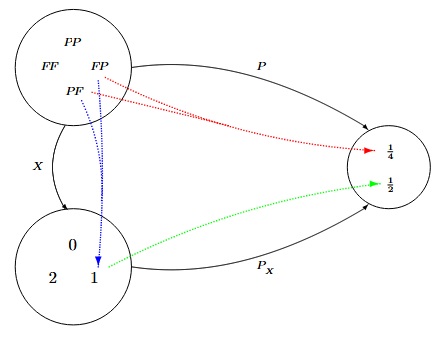
On joue à pile ou face deux fois de suite. On prend $\Omega=\{F\!F,F\!P,P\!F,P\!P\}$ comme univers et on considère la variable aléatoire $X$ qui compte le nombre de Pile réalisé. On a alors $F=\{0,1,2\}$ et le schéma suivant :
Propositions.23
-
Le triplet $(F,\mathcal{P}(F),P_{_X})$ est un espace probabilisé.
- Les variables aléatoires $X$ et $Y$ suivent la même loi $(X\sim Y)$ si et seulement si
$$\left\{
\begin{array}{ll}
P(X=a)=P(Y=a)&\text{ si }a\in X(\Omega)\cap Y(\Omega)\\
P(X=a)=0&\text{ si }a\in X(\Omega)\setminus Y(\Omega)\\
P(Y=a)=0&\text{ si }a\in Y(\Omega)\setminus X(\Omega)\\
\end{array}
\right.$$
- La relation $\sim$ est une relation d'équivalence sur l'ensemble des variables aléatoires.
Remarque.
Comme le montre la proposition 2, la loi d'une variable aléatoire ne change pas si on ajoute ou si on retire de $X(\Omega)$ des valeurs ayant une probabilité nulle. Il est donc parfois préférable lorsqu'on détermine la loi de $X$, de donner le support de $X$ au lieu de $X(\Omega)$ où :
$$\text{Supp}(X)\:\=\:\Big\{\:x\in X(\Omega)\:/\:P(X=x)>0\:\Big\}$$
Exemple.
On lance une pièce bien équilibrée jusqu'à obtenir pile. On note $X$ la variable aléatoire indiquant le rang du lancé pile. On a :
$$\left\{\begin{array}{l}
X(\Omega)\=\SetN^*\cup\{+\infty\}\\[0.1cm]
\forall k\in\SetN^*,\:P(X=k)=\left(\frac{1}{2}\right)^k\\[0.12cm]
P(X=+\infty)=0
\end{array}\right.
$$
Ici il est préférable de prendre :
$$\left\{\begin{array}{l}
Supp(X)\=\SetN^*\\[0.1cm]
\forall k\in\SetN,\:P(X=k)=\left(\frac{1}{2}\right)^k\\
\end{array}\right.
$$
|
III. Variables aléatoires discrètes.
III.3. Représentation graphique d'une variable aléatoire réelle.
Définition.
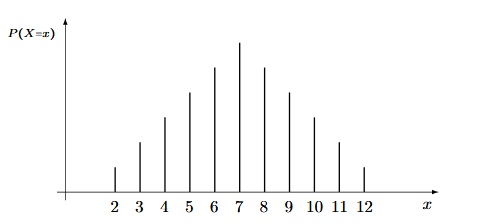
Pour représenter une variable aléatoire réelle, on utilise un diagramme en bâton. Les abscisses sont données par les valeurs $x_i$ de $X(\Omega)$ et la hauteur du bâton en $x_i$ est égale à $P(X=x_i)$.
Exemple.
On lance 2 dés à 6 faces. Notons $X$ la variable aléatoire égale à la somme des valeurs indiquées par les dés. La loi de $X$ est définie par $X(\Omega)=\{2,3,..., 12\}$ et :
$$
\begin{array}{|c|c|c|c|c|c|c|c|c|c|c|c|c|}
%\renewcommand\arraystretch{1.5}
\hline
\Haut{0.55}x&2&3&4&5&6&7&8&9&10&11&12\\[0.17cm]\hline
\Haut{0.65}P(X=x)&\frac{1}{36}&\frac{2}{36}&\frac{3}{36}&\frac{4}{36}&\frac{5}{36}&\frac{6}{36}&
\frac{5}{36}&\frac{4}{36}&\frac{3}{36}&\frac{2}{36}&\frac{1}{36}\\[0.3cm]\hline
\end{array}$$
Sa représentation graphique est :
|
III. Variables aléatoires discrètes.
III.4. Loi conjointe de variables aléatoires discrètes
Définitions.
Soient $X_1$,..., $X_n$ des variables aléatoires définies sur $(\Omega,\mathcal{A},p)$ à valeurs respectivement dans $F_1$,...,$F_n$.
- On définit $X=(X_1,...,X_n)$ la variable aléatoire conjointe $($ou vecteur aléatoire$)$ de $X_1$,..., $X_n$ par :
$$\fonction{X}{\Omega}{F_1\times...\times F_n}{\omega}{(X_1(\omega),...,X_n(\omega))}$$
- La loi de $X=(X_1,...,X_n)$ est appelées la loi conjointe de $X_1$,..., $X_n$.
- Les lois de $X_1$,...,$X_n$ sont appelées les lois marginales de $X=(X_1,...,X_n)$.
Remarque.
Puisque $X_1$, ..., $X_n$ sont discrêtes, il en est de même pour la loi conjointe $X=(X_1,...,X_n)$. Elle est donc définie par $X(\Omega)$ l'ensemble des valeurs prises par $X$ et les probabilités :
$$P\big(X=(a_1,...,a_n)\big)\:\=\:P\big(X_1=a_1\:\hbox{ et }\:X_2=a_2\:\hbox{ et }\:...\:\hbox{ et }\:X_n=a_n\big)$$
avec $(a_1,...,a_n)$ sont dans $X(\Omega)$.
Remarques - Le cas d'un couple de variable aléatoire.
Soit $X$ et $Y$ des variables aléatoires discrètes à valeurs respectivement dans $F$ et $G$.
- La loi du couple $(X,Y)$ est définie sur $F\times G$ par les probabilités :
$$P(X=a\:\hbox{ et }\:Y=b)$$ avec $(a,b)$ dans $X(\Omega)\times Y(\Omega)$.
- les lois marginale $X$ et $Y$ peuvent se retrouver grâce à loi conjointe :
$$\forall b\in Y(\Omega),\:\:\:P(Y=b)\:\=\:\sum_{a\in X(\Omega)}P(X=a,Y=b)$$
idem pour $X$.
Par contre, on ne peut pas retrouver la loi conjointe à partir des lois marginales.
- Dans le cas où $X$ et $Y$ prennent un petit
nombre de valeurs, on écrit en général la loi du couple sous la forme d'un tableau :
$$
\renewcommand{\arraystretch}{2}
\begin{array} {|c||c|c|c||c|}%
\hline
&X=x_1&X=x_2&...&~~~~~~~~\hbox{Total}~~~~~~~~\\
\hline
\hline
~~~~Y=y_1~~~~&~~P(X=x_1, Y=y_1)~~&~~P(X=x_2, Y=y_1)~~&~~~~...~~~~&P(Y=y_1)\\
\hline
Y=y_2&P(X=x_1, Y=y_2)&P(X=x_2, Y=y_2)&...&P(Y=y_2)\\
\hline
\vdots&\vdots&\vdots&\ddots&\vdots\\
\hline
\hline
\hbox{Total}&P(X=x_1)&P(X=x_2)&...&1\\
\hline
\end{array}%
$$
Exercice.24
On lance 2 dés à 6 faces et on considère les va :
$$\begin{array} {ccl}%
X&:&\hbox{valeur du premier dé}\\
Y&:&\hbox{maximum des deux dés}\\
\end{array}%
$$
Déterminer la loi conjointe $(X,Y)$ et les lois marginale $X$ et $Y$.
|
III. Variables aléatoires discrètes.
III.5. Opérations sur les variables aléatoires.
Définitions.
Soit $X$ une variable aléatoire à valeurs dans $F$ et $f$ une application de $F$ dans $G$ alors $f\:o\:X$ est une variable aléatoire à valeurs dans $G$. On la note $f(X)$, On dit que c'est l'image de $X$ par $f$.
Exemples.
Soient $X$ et $Y$ des variables aléatoires réelles définies sur le même univers.
- Par exemple $\:2X+1\:$, $\:X^2\:$, $\:abs(X)\:$ sont d'autres variables aléatoires.
- Si $\lambda$ et $\mu$ sont des réels, alors $\:\lambda X+\mu Y\:$ est encore une variable aléatoire. En effet, c'est l'image de la loi conjointe $(X,Y)$ par la fonction définie de $\SetR^2$ dans $\SetR$ par $f(x,y)=\lambda.x+\mu.y$.
- De même $XY$, $X+Y$, $\:\text{min}(X,Y)\:$, $\:\text{max}(X,Y)\:$ par exemple sont des variables aléatoires.
|