 |
Cours Espaces préhilbertiens réels. |
|
$$
\newcommand{\SetN}{\mathbb{N}}
\newcommand{\SetR}{\mathbb{R}}
\newcommand{\SetC}{\mathbb{C}}
\newcommand{\SetK}{\mathbb{K}}
\newcommand{\SetZ}{\mathbb{Z}}
\newcommand{\SetQ}{\mathbb{Q}}
\newcommand{\SetU}{\mathbb{U}}
\newcommand\ds[0]{\displaystyle}
\newcommand\PCar[1]{\large{\chi}_{#1}}
\newcommand{\=}{\:=\:}
\newcommand\tendvers[2]{\displaystyle\mathop{\longrightarrow}_{#1\rightarrow#2}}
\newcommand\tr[0]{\:^t\!}
\newcommand\limite[2]{\displaystyle\mathop{\text{lim}}_{#1\rightarrow#2}\:}
\newcommand\Sup[1]{\displaystyle\mathop{sup}_{#1}}
\newcommand\Inf[1]{\displaystyle\mathop{inf}_{#1}}
\newcommand\Haut[1]{}
\newcommand\vect[1]{\overrightarrow{#1}}
\newcommand\tendversCU[0]{\:\displaystyle\mathop{\Large\longrightarrow}_{n\rightarrow+\infty}^{_{CU}}\:}
\newcommand\tendversCS[0]{\:\displaystyle\mathop{\Large\longrightarrow}_{n\rightarrow+\infty}^{_{CS}}\:}
\newcommand\tendversCN[0]{\:\displaystyle\mathop{\Large\longrightarrow}_{n\rightarrow+\infty}^{_{CN}}\:}
\newcommand\tendversCUS[0]{\:\displaystyle\mathop{\Large\longrightarrow}_{n\rightarrow+\infty}^{_{CUS}}\:}
\newcommand\tendversNorme[1]{\:\displaystyle\mathop{\Large\longrightarrow}_{n\rightarrow+\infty}^{#1}\:}
\newcommand\simL[0]{\displaystyle\mathop{\sim}_{^{^L}}}
\newcommand\simC[0]{\displaystyle\mathop{\sim}_{^{^C}}}
\newcommand\simLC[0]{\displaystyle\mathop{\sim}_{^{^{LC}}}}
\newcommand\fonction[5]{
\begin{array}{cccc}
#1\::\:& #2 & \rightarrow & #3 \\
& #4 & \mapsto & \ds #5 \
\end{array}}
$$
| Liste chapitres | Plan du chapitre |
|
|
||||||
| |||||||||
V. Limite et continuité. V.1. Limite d'une suite
Définition.
Soit $E$ un espace vectoriel préhilbertien réel et $\|.\!.\!.\|$ la norme euclidienne associée.
La suite $(u_n)$ tend vers un vecteur $l$ de $E$, et on note $\:u_n\tendvers{n}{+\infty}l\:$, si et seulement si :
$$\forall\varepsilon\in\SetR^*_+,\:\exists N\in\SetN,\forall n\geq N,\:\|u_n-l\|\leq\varepsilon$$
C'est la définition de la limite d'une suite réelle en remplaçant la valeur absolue par la norme euclidienne.
Caractérisation.46
On peut toujours se ramener à la convergence d'une suite réelle puisque :
$$u_n\tendversNorme{\|\:\:\|}l\:\:\:\:\:\:\:\:\Longleftrightarrow\:\:\:\:\:\:\:\:\|u_n-l\|\tendvers{n}{+\infty}0$$
Théorème.47
Exemples.
$$n\left(\begin{array} {ccc}%
\arctan\left(\frac{1}{n}\right)\\
\cos\left(\frac{1}{n}\right)-1\\
\end{array}%
\right)\:\:\tendvers{n}{+\infty}\:\:\left(\begin{array} {ccc}%
1\\
0
\end{array}%
\right)
\hskip2cm
\frac{1}{n}\left(\begin{array} {ccc}%
(-1)^n&n+1\\
\Haut{0.48}n^2\sin\left(\frac{1}{n}\right)&1
\end{array}%
\right)\:\:\tendvers{n}{+\infty}\:\:\left(\begin{array} {ccc}%
0&1\\
\Haut{0.48}1&0
\end{array}%
\right)$$
Exercice.48
| |||||||||
V. Limite et continuité. V.2. Quand une notion vous manque... Suites de Cauchy $($HP$)$.
Définition.
Soit $(E,\|.\!.\!.\|)$ un espace vectoriel normé.
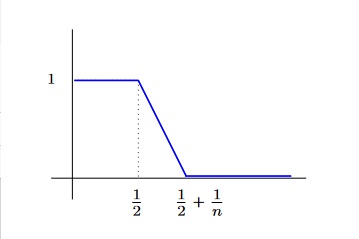
Exercice - une suite de Cauchy non convergente.49
Soit $E=C^0([0,1],\SetR)$ muni de son produit scalaire usuel. Considérons
pour tout $n$ de $\SetN^*$ l'application $f_n$ de $E$ définie par :
| |||||||||
V. Limite et continuité. V.3. Ouverts/Fermés.
Définition temporaire.
Soit $E$ un espace préhilbertien réel.
Exemples.50
Soient $a$, $b$, $c$ et $d$ dans $\SetR$ tels que $a < b$ et $c < d$.
Exercice.51
Notons
$$
A=\left\{\:\left[\begin{array} {ccc}%
a&b\\
c&d\\
\end{array}%
\right]\:\:\:/\:\:\:a,b,c,d\in[0,1]\right\}
\hskip1.5cm
B=\left\{\:\left[\begin{array} {ccc}%
a&b\\
c&d\\
\end{array}%
\right]\:\:\:/\:\:\:a,b,c,d\in\SetR^*\:\right\}
$$
Montrer que $A$ est un fermé et $B$ est un ouvert de $\mathcal{M}_{n}(\SetR)$
| |||||||||
V. Limite et continuité. V.4. Limite et continuité d'une application
Définition.
Soient $E$ et $F$ des espaces préhilbertiens réels et $\|.\!.\!.\|_{_E}$, $\|.\!.\!.\|_{_F}$ les normes euclidiennes associées.
Notons $f$ une application d'un sous-ensemble $D$ de $E$ dans $F$.
Remarques.
Exercice.52
Montrer que l'application $f$ de $(\SetR^2,\|.\!.\!.\|_2)$ dans $(\SetR,|.\!.\!.|)$ suivante admet une limite en 0 :
$$f(x,y)=\frac{x^2y^2}{x^2+y^2}$$
| |||||||||